Saturday, March 26, 2011

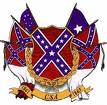
The Tyrant, The Butcher And The Anti-Christ


(I made these.  It's a great site.  I made some for Obama, too.)

Friday, March 25, 2011

The Great Seal Of The Confederacy

From civilwarhome:


The Great Seal of the Confederacy


Deo Vindice

"God Will Vindicate"


The Great Seal of the Confederate States of America was engraved in 1864, by the late Joseph S. Wyon, of London, England, predecessor of Messrs J. S. and A. B. Wyon, chief engravers of Her British Majesty's seals, etc., and reached Richmond not long before the evacuation of the city, April 3, 1865. It was of silver, and in diameter measured nearly four inches. At the evacuation it was overlooked by the Confederate authorities, and subsequently fell into the possession of the late genial and accomplished Colonel John T. Pickett, of Washington, D.C., who, after having a number of electrotype copies in copper, silver and gold plating made from it, presented the original to Colonel William E. Earle, of Washington, D.C. This last gentleman, on December 27th, 1888, formally presented it to the State of South Carolina. The announcement of the gift elicited from the Picayune, in its issue of January 6, 1889, the interesting report of an interview, by one of its representatives, held with Hon. Thomas J. Semmes, of New Orleans, which follows:


"Mr. Semmes said it always afforded him pleasure to converse on the events of the war, particularly the transactions of the Confederate Senate. He was attorney-general of Louisiana in 1861. When it became necessary to elect to the Confederate Senate, organized under the new constitution, Mr. Semmes and General Edward T. Sparrow were chosen senators from this State. In drawing for terms he drew that for four years, while General Sparrow drew that for six years. This was at Richmond, Va., in February, 1862.

"In speaking of his services in the Senate, Mr. Semmes said he was appointed a member of the finance committee in conjunction with Hon. R. M. T. Hunter, of Virginia, and Hon. Robert Barnwell, of South Carolina and a member of the judiciary committee, of which Hon. B. H. Hill was chairman. He was also chairman of the joint committee on the flag and seal of the Confederate States. He drafted, under the direction of Hon. R. M. T. Hunter, the 'tax in kind' bill, which practically supported the Confederacy during the last two years of the war.

"As member of the finance committee, he advocated the sealing and calling in of the outstanding Confederate currency, on the ground that the purchasing power of the new currency to be issued in exchange would be greater than the total amount of the outstanding currency in its then depreciated condition. He made a report from the judiciary committee adverse to martial law.

"Upon being questioned as to the seal which he had designed, Mr. Semmes said it was a device representing an equestrian portrait of Washington (after the statue which surmounts his monument in the capitol square at Richmond), surrounded with a wreath, composed of the principal agricultural products of the Confederacy, and having around its margin the words: 'Confederate States of America, 22d February, 1862,' with the motto, 'Deo vindice.'

"In the latter part of April, 1864, quite an interesting debate was had on the adoption of the motto. The House resolutions fixing the motto as 'Deo Duce Vincemus' being considered, Mr. Semmes moved to substitute ' Deo vindice majores aemulamur.' The motto had been suggested by Professor Alexander Dimitry. Mr. Semmes thought 'Deo vindice' sufficient and preferred it. He was finally triumphant."

In this connection it is appropriate and interesting to reproduce the speech made by Mr. Semmes on that occasion. It was as follows:

"MR. PRESIDENT--I am instructed by the committee to move to strike out the words "duce vincemus" in the motto and insert in lieu thereof the words "Vindice majores aemulamur," "Under the guidance and protection of God we endeavor to equal and even excel our ancestors." Before discussing the proposed change in the motto, I will submit to the Senate a few remarks as to the device on the seal.

"The committee has been greatly exercised on this subject, and it has been extremely difficult to come to any satisfactory conclusion. This is a difficulty, however, incident to the subject, and all that we have to do is to avoid what Visconti calls 'an absurdity in bronze.'

"The equestrian statue of Washington has been selected in deference to the current popular sentiment. The equestrian figure impressed on our seal will be regarded by those skilled in glyptics as to a certain extent indicative of our origin. It is a most remarkable fact that an equestrian figure constituted the seal of Great Britain from the time of Edward the Confessor down to the reign of George III, except during the short interval of the protectorate of Cromwell, when the trial of the King was substituted for the man on horseback. Even Cromwell retained the equestrian figure on the seal of Scotland, but he characteristically mounted himself on the horse. In the reign of William and Mary the seal bore the impress of the king and queen both mounted on horseback.

"Washington has been selected as the emblem for our shield, as a type of our ancestors, in his character of princeps majorum. In addition to this, the equestrian figure is consecrated in the hearts of our own people by the local circumstance that on the gloomy and stormy 22d of February, 1862, our permanent government was set in motion by the inauguration of President Davis under the shadow of the statue of Washington.

"The committee are dissatisfied with the motto on the seal proposed by the House resolution. The motto proposed is as follows: 'Deo Duce Vincemus'--(Under the leadership of God we will conquer).

"The word ' duce' is too pagan in its signification, and is degrading to God, because it reduces him to the leader of an army; for scarcely does the word 'duce' escape the lips before the imagination suggests 'exercitus,' an army for a leader to command. It degrades the Christian God to the level of pagan gods, goddesses and heroes, as is manifest from the following quotation; 'Nil desperandum Tenero duce.' This word duce is particularly objectionable because of its connection with the word 'vincemus'--(we will conquer). This connection makes God the leader of a physical army, by means of which we will conquer, or must conquer. If God be our leader we must conquer, or he would not be the God of Abraham, and of Isaac, and of Jacob, nor the God of the Christian. This very doubt implied in the word 'vincemus' so qualifies the omnipotence of the God who is to be our 'leader,' that it imparts a degrading signification to the word 'duce' in its relations to the attributes of the Deity.

"The word 'vincemus' is equally objectionable because it implies that war is to be our normal state; besides, it is in the future tense --' we will conquer.' The future is always uncertain, and ,therefore, it implies doubt. What becomes of our motto when we shall have conquered? The future becomes an accomplished fact, and our motto thus loses its significance.

"In addition to this there are only two languages in which the words will and shall are to be found--the English and the German--and in those they are used to qualify a positive condition of the mind and render it uncertain; they are repugnant to repose, quiet, absolute and positive existence.

"As to the motto proposed by us, we concur with the House in accepting the word 'Deo'--God. We do so in conformity to the expressed wishes of the framers of our Constitution, and the sentiments of the people and of the army.

"The preamble of the Provisional Constitution declares that 'We, the deputies of the sovereign and independent States of South Carolina, etc., invoking the favor and guidance of Almighty God, do ordain,' etc.

"In this respect both our Constitutions have deviated in the most emphatic manner from the spirit that presided over the construction of the Constitution of the United States, which is silent on the subject of the Deity.

"Having discarded the word 'duce,' the committee endeavored to select in lieu of it a word more in consonance with the attributes of the Deity, and therefore more imposing and significant. They think success has crowned their efforts in the selection of the word 'vindex,' which signifies an assenter, a defender, protector, deliverer, liberator, a mediator and a ruler or guardian. 'Vindex' also means an avenger or punisher.

"No word appeared more grand, more expressive or significant than this. Under God as the asserter of our rights, the defender of our liberties, our protector against danger, our mediator, our ruler and guardian, and, as the avenger of our wrongs and the punisher of our crimes, we endeavor to equal or even excel our ancestors. What word can be suggested of more power, and so replete with sentiments and thoughts consonant with our idea of the omnipotence and justice of God?

"At this point the committee hesitated whether it were necessary to add anything further to the motto 'Deo Vindice.' These words alone were sufficient and impressive, and, in the spirit of the lapidary style of composition, were elliptical and left much to the play of the imagination. Reflection, however, induced us to add the words 'majores aemulamur,' because without them there would be nothing in the motto referring to the equestrian figure of Washington. It was thought better to insert something elucidative or adaptive of the idea to be conveyed by that figure. Having determined on this point, the committee submitted to the judgment of the Senate the words ' majores aemulamur,' as best adapted to express the ideas of 'our ancestors.' 'Patres' was first suggested, but abandoned because 'majores' signifies ancestors absolutely, and is also more suggestive than 'patres.' The latter is a term applied to our immediate progenitors who may be alive, whereas ' majores' conveys the idea of a more remote generation that has passed away.

"That being disposed of, the question arose as to the proper signification of the word 'aemulamur.' Honorable emulation is the primary signification of the word; in its secondary sense it is true it includes the idea of improper rivalry, or jealousy. But it is used in its primary and honorable sense by the most approved authors.

"The secondary and improper sense of the aemulari is excluded in the proposed motto by the relation it bears to 'Deo vindice.' This relation excludes the idea of envy or jealousy, because God, as the asserter of what is right, justifies the emulation, and as a punisher of what is wrong checks excess in case the emulation runs into improper envy or jealousy. In adopting the equestrian figure of Washington, the committee desires distinctly to disavow any recognition of the embodiment of the idea of the 'cavalier.' We have no admiration for the character of the cavalier of 1640 any more than for his opponent, the Puritan. We turn with disgust from the violent and licentious cavalier, and we abhor the acerb, morose and fanatic Puritan, of whom Oliver Cromwell was the type. In speaking of Cromwell and his character, Guizot says that ' he possessed the faculty of lying at need with an inexhaustible and unhesitating hardihood which struck even his enemies with surprise and embarrassment.'

"This characteristic seems to have been transmitted to the descendants of the pilgrims who settled in Massachusetts Bay to enjoy the liberty of persecution. If the cavalier is to carry us back to days earlier than the American Revolution, I prefer to be transported in imagination to the field of Runnymede, when the barons extorted Magna Charta from the unwilling John. But I discard all reference to the cavalier of old, because it implies a division of society into two orders, an idea inconsistent with confederate institutions."

Mr. Semmes moved to amend by substituting "vindice" for "duce," and it was agreed to.

In taking his leave, the reporter was informed by Mr. Semmes that he did not know the seal was in existence and was glad to learn that it had been presented to the State of South Carolina, the first State which seceded from the Union.


Source: Southern Historical Society Papers. Vol. XVI. Richmond, Va., January-December. 1888.

This Page last updated 06/01/02


Sunday, March 20, 2011

ATM Sunday Message

From the Arkansas Division, Sons of Confederate Veterans:


Army of


Trans

Mississippi

Sons of Confederate Veterans

Information for the Army on the Move !!!


Brothers and fellow Compatriots:


Below is my message for Sunday, March 20th. As always, please feel free to forward or reply. Your comments are most welcome. It may also be used as a Chaplain's article for your camp or other newsletter.


To those who forward this message to other people or groups, I thank you. It is very much appreciated.


May our Lord bless you all in His service and in service to our most worthy Confederation.


Bro. Len Patterson, Th.D.


Chaplain, Army of Trans-Mississippi


Member, Chaplain's Corps Committee


Sons of Confederate Veterans


------------------------------------------------------------------------------------------------- A Work In Progress.


This morning, as I walked around outside, coffee in hand, trying to think of a subject for this morning's Sunday Message, a neighbor came by walking her dog. I made a nice comment about her dog (I never met a dog I didn't like), and we exchanged a few brief pleasantries. She then said, "You have a nice house." I couldn't help but wonder, Compared to what? I thanked her, and replied to her very kind remark, "It's a work in Progress."


When my wife and I bought this house I knew there was some work to be done which I felt could be accomplished before we moved in, and for the most part it was. However, as the work was being done, I began to realize there was much more needed to improve the efficiency and appearance of our new home. So now, seven years later it's still a work in progress.


This applies to people as well as houses. No one knows more about life than a sixteen-year-old who has never had the responsibility of providing a loaf of bread for a family. No one knows more about the Bible than someone who has read a few verses and went to Sunday School a time or two. No one knows more about what's going on in a church than someone who never attends. And of course, no one knows more about the Sons of Confederate Veterans than someone who doesn't know a thing about who we are or what we do. We sometimes call them "Armchair quarterbacks" or "Jailhouse lawyers."


It seems the less someone knows about something, the more they think they know, and unfortunately, the more willing they are to express their ideas. As someone once said, "I little knowledge is a dangerous thing." We learn about life when we begin to live it. Then we realize how much more difficult it is than our parents made it seem. Again, it's been said, "The older I get, the smarter my father becomes." We gain knowledge about the Bible when we begin to study it. Then we learn that it's deeper and much more complex than we imagined. The more we learn, the more we know, and the more we know, the more we understand, and the more we understand, the more we realize we don't know, and the more we realize we don't know, the more we study and learn. It's a work in progress.


It's called growth. Through experience and study we are all growing in life, and in knowledge. But, we should also be growing spiritually. The best explanation for spiritual growth I know of was spoken by John the Baptist, when He said, "He (meaning Jesus) must increase, but I must decrease." (John 3: 30) As our Lord becomes more and more important and central in our life, and we become less and less, we grow . . . and that's a work in progress.


Bro. Len Patterson, Th.D

Chaplain, Army of Trans-Mississippi


Thursday, March 17, 2011

Historian Has New Take On Civil War [sic}

From Rebellion:

Historian has new take on Civil Warfrom feed/http://www.dixienet.org/rebellion/atom.xml by Old RebelI'm no fan of historian David Goldfield, but his latest book is clearly better than his past efforts. Instead of toeing the party line that the WBTS was a glorious war of liberation, he portrays it as the nation's greatest failure. He has a point, though he still misses the heart of the matter:


In his new book, "America Aflame: How the Civil War Created a Nation" (Bloomsbury; $35), Goldfield describes the war not as a triumph of freedom but as America's biggest failure - a conflict that cost 620,000 American lives, the equivalent in today's population of 10 million people.


"The question I want readers to ask is, 'Was this necessary?'" Goldfield says. ...


"We've grown up thinking the war saved the Union and liberated 4 million human beings and it was good. I'm saying the results weren't as clear cut and there may have been a better way to achieve those results."


Publishers Weekly says that Goldfield "courts controversy by shifting more responsibility for the conflict to the activist North and away from intransigent slaveholders." Still, the review says, "he presents a superb, stylishly written historical synthesis that insightfully foregrounds ideology, faith and public mood."


The War of Northern Aggression was just another instance of the centralizing trend of the late nineteenth century. Prussia fought three wars to forge the German Empire, Piedmont-Sardinia waged war on its Italian neighbors to form the Kingdom of Italy, and Japan centralized power around the emperor. Lincoln managed to centralize the former Republic of Republics under the domination of New England industrialists and the central government. The WBTS, like all wars, was about power, not liberation.

Sunday, March 13, 2011

The Lincoln Mythology Is Born

From The Southern National Congress:

Lincoln Mythology is Born


Commentary by Steve Scroggins

March 4th, 2011 marks the 150th Anniversary of Abraham Lincoln’s inauguration as President of the United States. Lincoln idolators and court ‘historians’ are certain to gush forth with fluff and flowery prose about how Lincoln “saved the Union” and “freed the slaves” when history shows that he did neither -- in fact, he did just the opposite, as we'll show below.


1. Lincoln the Great Emancipator: He reluctantly inaugurated war to abolish slavery

2. Lincoln "Saved the Union" from those who would "destroy the Union"

3. Lincoln had to respond to Fort Sumter to put down treasonous secession

4. Lincoln the Humanitarian

5. Lincoln the champion of personal liberty and defender of the Constitution

1. Lincoln the Great Emancipator: He reluctantly inaugurated war to abolish slavery

First of all, war was NOT required to end slavery. No other country in the world required war to end it; neither did America. Chattel slavery was doomed by the 1850s and on its way to extinction everywhere in the western Christian world. Brazil, a former Portuguese colony, was the last to abolish slavery in the western hemisphere in 1888. It is a lingering fallacy that it took war to end slavery in America.


Lincoln stated in his first inaugural address that he had no intention, no inclination and no legal authority to abolish slavery where it existed. He stated this in writing on numerous occasions. In the same address, Lincoln stated his support for the Corwin Amendment - otherwise known as the "Slavery Forever Amendment" -- which would constitutionally enshrine slavery permanently beyond the jurisdiction of the Congress.


The Republican party platform opposed the expansion of slavery to the western territories for economic and social reasons. The Republicans didn't want any blacks or Indians living anywhere near them. Illinois, it should be noted, had passed law to prohibit the settling or residence of blacks in Illinois. The Lincoln Dream was for a lilly-white America with no blacks or Indians. His soldiers, trained in the art of making war on southern civilians, did a fair job of genocide against the plains Indians after the war.


"[T]he Union ... will constitutionally defend and maintain itself... In doing this there needs to be no bloodshed or violence, and there shall be none unless it be forced upon the national authority. The power confided to me will be used to hold, occupy, and possess the property and places belonging to the Government and to collect the duties and imposts; but beyond what may be necessary for these objects, there will be no invasion, no using of force against or among the people anywhere." --Abraham Lincoln, from inaugural address, March 4, 1861.


In his inaugural address, Lincoln promised not to invade or start a war EXCEPT to enforce the tariff law and hold federal forts for the purpose of tariff collection. His object was to quell the secession movement and force the recently departed states to return to the union, or at least to pay the tariffs as if they were still part of the Union. Lincoln claimed in the address that states did not have the authority to secede or leave the union. This is, of course, a 180 degree about-face from his stated opinion just 14 years earlier.


"Any people anywhere, being inclined and having the power, have the right to rise up and shake off the existing government and form a new one that suits them better. This is a most valuable, --a most sacred right--a right, which we hope and believe, is to liberate the world." --Abraham Lincoln, from the Congressional Record, Jan. 12, 1847.


Lincoln's 1861 argument was logically ridiculous. Lincoln claimed that somehow the union came before the states which formed the union by ratifying the Constitution. That's like saying that a marriage came before the two people who were joined in the marriage.


Lincoln argued in his 1861 Inaugural address that "Perpetuity is implied, if not expressed, in the fundamental law of all national governments." Note that the Framers specifically avoided the use of the words "national" and "perpetual" and struck them from proposed documents. James Madison made it clear that the people, their liberties and their "safety and happiness" were more important than any form of government when he said, "The safety and happiness of society are the objects at which all political institutions must be sacrificed."


Lincoln was inaugurated March 4th. After Lincoln's secretary of state promised to evacuate and surrender Fort Sumter for weeks, Lincoln dispatched an armada to reinforce and resupply Fort Sumter in early April, an act of war. Lincoln let the Confederates know it was coming. To miminize the loss of life, the Confederates decided to bombard the Fort into submission before warships arrived. Fort Sumter was surrendered April 12th. It should be noted that there was no loss of life in the attack and the federal garrison was permitted to leave peacefully after the surrender. Lincoln had provoked the South into firing the first shots. Again, there was no person killed or injured at Fort Sumter, but it fired a war fever in the north.


On April 15th Lincoln called for 75,000 volunteers with which to invade the South and enforce the tariff laws. He ordered a naval blockade of southern ports, raised an army, gathered war materiel and committed other acts of war without the Constitutionally required Declaration of War from Congress.


When the Congress finally convened in July 1861, they rubber stamped his aggressive military actions since April 15th. They also confirmed his motive and objectives. The Crittenden-Johnson Resolution dated July 25, 1861 stated explicitly that the purpose of the war was to "preserve the union" and "not to interfere in the established institutions of the states" nor to limit their rights and freedoms in any other way.


Once Lincoln started the war by attempting to reinforce Fort Sumter by force, he repeatedly stated that his intent was to "save the Union" and his war effort had nothing to do with slavery. A year and a half after hostilities commenced, in his August 1862 correspondence with Horace Greeley (New York Tribune), he emphatically stated that slavery was irrelevant to the war -- it was only about restoring (preserving) the Union. This was just a month before the Emancipation Proclamation was issued.


"My paramount object in this struggle is to save the Union, and is not either to save or to destroy slavery. If I could save the Union without freeing any slave I would do it, and if I could save it by freeing all the slaves I would do it; and if I could save it by freeing some and leaving others alone I would also do that. What I do about slavery, and the colored race, I do because I believe it helps to save the Union; and what I forbear, I forbear because I do not believe it would help to save the Union." --Abraham Lincoln, from letter to Horace Greeley, Aug. 22, 1862


Regardless of any sophistry or distortions to the contrary, the historical record shows incontrovertably that Lincoln and the U.S. Congress started and prosecuted the war for the purpose of preventing southern secession and independence and to enforce the tariff collections, to "preserve the union" as they called it. Though slavery (especially expansion) was a source of regional conflict, it was NOT the purpose of the war.


And what did the participants in the war think? General John B. Gordon gives us an assessment:


"But slavery was far from being the sole cause of the prolonged conflict. Neither its destruction on the one hand, nor its defence on the other, was the energizing force that held the contending armies to four years of bloody work. I apprehend that if all living Union soldiers were summoned to the witness-stand, every one of them would testify that it was the preservation of the American Union and not the destruction of Southern slavery that induced him to volunteer at the call of his country. As for the South, it is enough to say that perhaps eighty percent of her armies were neither slave-holders, nor had the remotest interest in the institution. No other proof, however, is needed than the undeniable fact that at any period of the war from its beginning to near its close the South could have saved slavery by simply laying down its arms and returning to the Union." --General John B. Gordon, from Reminiscences of the Civil War, page 19


But what about the Emancipation Proclamation, you ask? It was strictly a war measure aimed at weakening the South by creating chaos or inciting slave insurrection. Another obvious purpose was to keep Britain and the European powers out of the war -- many of those nations wanted to trade with the South for cotton. Here's a sample of how the British press saw the Proclamation:


"The Union government liberates the enemy’s slaves as it would the enemy’s cattle, simply to weaken them in the conflict. The principle is not that a human being cannot justly own another, but that he cannot own him unless he is loyal to the United States." --London Spectator, 1862


"The Northern onslaught upon slavery was no more than a piece of specious humbug designed to conceal its desire for economic control of the Southern states." --Charles Dickens, 1862


As the secession "crisis" started in December 1860 and continued into January 1861, the initial reaction of most people in the North was "let them go in peace." They acknowledged that the principles of the Declaration of Independence, including the 'consent of the governed', prohibited coercion of the southern states to remain in the union by force. But by February and March, the northern industrialists and shipping interests had leaned on the northern editors and made them aware of the financial losses southern independence would bring the northern states. Northern editorials changed from "let them go" to "heck, no, we'll go broke." See a selection of Northern editorials for the flavor of the thought and note the change.


As the saying goes, "follow the money." The real power and wealth wanted war to protect their financial interests and to keep the southern states on the taxpaying plantation to pay for their subsidized infrastructure and favored special interests. It should be noted that the Republican party platform included raising protectionist tariffs (paid mostly by the southern states)... and the Congress passed the Morrill Tariff which doubled the tax rates, and President Buchanan signed it into law just two days before Lincoln was inaugurated.


From this it appears that Charles Dickens summed up the yankee motivation best, a "desire for economic control of the Southern states."


2. Lincoln "Saved the Union" from those who would "destroy the Union"


Lincoln didn't save anything, just the opposite. We started the war with a Constitutional Republic and ended with a consolidated empire, ruled from a central capitol with the States neutered. The Southern states didn't seek to "destroy" anything. All they wanted was peaceful separation. There would have been no war if Lincoln hadn't raised the troops and launched an invasion and blockade. Remember, not one person had been killed or injured in the taking of Fort Sumter. The Southern states tried repeatedly to open negotiations to pay for the federal properties in their territory, their share of the national debt (infinitely smaller than today), and so on. Lincoln would not even discuss it. A man with his considerable political skills could have resolved the issues without war. No, the party that elected Lincoln was determined to keep the southern states as economic colonies -- even if they had to exterminate all southerners to do it.


"The Gettysburg speech was at once the shortest and the most famous oration in American history... The doctrine is simply this: that the Union soldiers who died at Gettysburg sacrificed their lives to the cause of self-determination – that government of the people, by the people, for the people, should not perish from the earth. It is difficult to imagine anything more untrue. The Union soldiers in the battle actually fought against self-determination; it was the Confederates who fought for the right of their people to govern themselves." --H.L. Mencken [emphasis added]


"[T]he consolidation of the states into one vast republic, sure to be aggressive abroad and despotic at home, will be the certain precursor of that ruin which has overwhelmed all those [republics] that have preceded it." --Robert E. Lee, letter to Lord Acton, 1866


The purpose of the war was to finally realize the Hamiltonian dream of a consolidated, monopolistic government that would pursue what Hamilton himself called 'national greatness' and 'imperial glory.' The purpose of the war, in other words, was a New Birth of Empire, one that would hopefully rival the Europeans in the exploitation of their own citizens in the name of the glory of the state." --Thomas DiLorenzo, from Malice Toward All, Charity Toward None: The Foundations of the American State


3. Lincoln had to respond to Fort Sumter to put down treasonous secession


As noted above, no person was killed in the taking of Fort Sumter.


Secession cannot be reasonably considered treason. Most Americans celebrate that secession document called the Declaration of Independence every July 4th. We don't call it "Treason Day."


The states of New York, Rhode Island and Virginia in their ratification documents explicitly reserved the right to leave the union whenever in their opinion it was best for the security, happiness and liberty of their people. The other states reserved these rights implicitly. It was the understanding of all the Framers and those who ratified the Constitution in their respective states that the states "retain every power not expressly relinquished" in the Constitution. Since secession was not mentioned, that right is retained. This understanding is underscored by the 9th and 10th Amendments to the Constitution. If any thought for a moment they were bound in perpetuity, almost no states, and certainly not the requisite nine states would have ratified. They knew they didn't have the right to bind their posterity, but that they could choose for themselves their form of government.


The cadets at the U.S. Military Academy at West Point studied the Constitution using an 1829 text written by William Rawle, a Philadelphia attorney, who was the U.S. District Attorney for Pennsylvania under the Washington Administration, one who prosecuted the rebels of the Whisky Rebellion. Chapter 32, entitled On the Permanance of the Union, contains the following text:


The Union is an association of the people of republics; its preservation is calculated to depend on the preservation of those republics. The people of each pledge themselves to preserve that form of government in all. Thus each becomes responsible to the rest, that no other form of government shall prevail in it, and all are bound to preserve it in every one. ...If a faction should attempt to subvert the government of a state for the purpose of destroying its republican form, the paternal power of the Union could thus be called forth to subdue it.


Yet it is not to be understood, that its interposition would be justifiable, if the people of a state should determine to retire from the Union...


It depends on the state itself to retain or abolish the principle of representation, because it depends on itself whether it will continue a member of the Union. To deny this right would be inconsistent with the principle on which all our political systems are founded, which is, that the people have in all cases, a right to determine how they will be governed. [emphasis added]

--William Rawle, Chapter 32, A VIEW of the CONSTITUTION of the United States of America


Charles Adams, in his book entitled When in the Course of Human Events: Arguing the Case for Southern Secession, obliterates the weak and faulty arguments that secession is not a right of the states.


Jefferson Davis was held without trial in military prison at Fortress Monroe for two years after the war. The yankee prosecutors realized they could not win a conviction of Davis in open court for treason. Davis wanted nothing more than his day in court, but it was denied when the indictment for treason was dismissed. On that same date, treason indictments on 19 other Confederate officers were dismissed.


The Constitution defines treason against the United States to consist only in "levying War against them or in adhering to their enemies, giving them aid or comfort." Under that definition, it's Lincoln who could be convicted of treason since he organized and ordered that war be levied against the Southern states. When the Constitution uses the word "them" it refers to the States. Davis, on the other hand, hoped that the southern states could leave peacefully. Defending against an armed invasion is not treason. There was never any intent to interfere with the government of the United States nor to occupy any territory of the remaining states in the U.S. Thus, the term 'civil war' is a ridiculous misnomer.


4. Lincoln the Humanitarian


It should be remembered that Lincoln launched an unnecessary war for economic reasons that cost the lives of over 620,000 American soldiers, an estimated 50,000 civilians and left probably over a million horribly maimed and wounded. Standardized for today's population, that would be the equivalant of six million Americans dying in four years. Such unnecessary bloodshed earns Lincoln a place in the pantheon of 20th century killers such as Stalin, Pol Pot, and Adolph Hitler.


Sheridan and Sherman both noticed that Lincoln always asked to be regaled with stories of civilian suffering as the yankee armies practiced their raping, looting and vandalism. What kind of human being wants to hear such horror stories? See Walter Brian Cisco's War Crimes Against Southern Civilians Some of it is detailed in Thomas DiLorenzo's essay entitled, Malice Toward All, Charity Toward None: The Foundations of the American State


Lincoln actively advocated for "colonization" (deportation) of all blacks from North America. As noted earlier, Lincoln's Dream was an all-white America. He actively planned and lobbied for support to round up all blacks who were emancipated by any means and send to them outside the United States (to South America, the Caribbean or back to Africa). This part of the historical record is irrefutable, yet the Court Historians seems to omit such details while painting Lincoln as an angel.


5. Lincoln the champion of personal liberty and defender of the Constitution


This one is real howler. Lincoln crushed the Constitution while his rhetoric professed to revere it.


Lincoln illegally suspended Habeas Corpus. He imprisoned tens of thousands of Northern citizens without trial for expressing views contrary to his, or for criticizing the war effort. Lincoln shut down over 300 opposition newspapers in the North. One such editor/citizen imprisoned was mayor of Baltimore, the grandson of Frances Scott Key (author of the Star Spangled Banner). He arrested much of the Maryland legislature to prevent them from discussing secession. When Supreme Court Chief Justice Roger B. Taney ruled that Lincoln's suspension of Habeas Corpus was unconstitutional, Lincoln issued as arrest warrant for Taney. Though the arrest was never made, the intimidating threat was made.


Jeffrey Rogers Hummel in his book entitled Emancipating Slaves, Enslaving Free Men makes the case eloquently that while the 13th Amendment ended chattel slavery in America, the result of the war was to enslave all Americans at tax slaves. The growth of the Empire was enabled once the States had been neutered and the Constitution crushed in practice.


Conclusion


This has ran much longer than originally intended. And we covered only the top five Lincoln Myths. Lincoln didn't "save the Union," he destroyed the decentralized and voluntary Republic as defined in the Constitution. He didn't "free the slaves," he enslaved all Americans to their government. The name Lincoln shouldn't pass any American's lips unless followed by a contemptuous expectoration.


"It is a testament to the effectiveness of 140 years of government propaganda that a 308 page book filled with true facts about Lincoln could be entitled "The Lincoln No One Knows." It is not a matter of a poorly-performing government education system but quite the opposite: The government schools have performed superbly in indoctrinating generations of American school children with a pack of lies, myths, omissions, and falsehoods about Lincoln and his war of conquest. As Richard Bensel wrote in Yankee Leviathan, any study of the American state should begin in 1865. The power of any state ultimately rests upon a series of government-sponsored myths, and there is none more prominent than the Lincoln Myth." --Thomas DiLorenzo, from The Unknown Lincoln


Gordon on the War


"Prior to actual secession there was even at the South more or less division of sentiment--not as to principle, but as to policy. Scarcely a man could be found in all the Southern States who doubted the constitutional right of a State to withdraw from the Union; but many of its foremost men thought that such movement was ill-advised or should be delayed. Among these were Robert E. Lee, who became the commander-in-chief of all the Confederate armies; Alexander Hamilton Stephens, who became the Confederate Vice-President; Benjamin H. Hill, who was a Confederate senator and one of the Confederate administration's most ardent and perhaps its most eloquent supporter; and even Jefferson Davis himself is said to have shed tears when, at his seat in the United States Senate, he received the telegram announcing that Mississippi had actually passed the ordinance of secession."


"He agreed, however, with an overwhelming majority of the Southern people, in the opinion that both honor and security, as well as permanent peace, demanded separation. Referring to the denial of the right of Southerners to carry their property in slaves into the common Territories, he said: 'Your votes refuse to recognize our domestic institutions, which preëxisted the formation of the Union--our property, which was guarded by the Constitution. You refuse us that equality without which we should be degraded if we remained in the Union. . . . Is there a senator on the other side who, to-day, will agree that we shall have equal enjoyment of the Territories of the United States? Is there one who will deny that we have equally paid in their purchases and equally bled in their acquisition in war? . . . Whose is the fault, then, if the Union be dissolved? . . . If you desire, at this last moment, to avert civil war, so be it; it is better so. If you will but allow us to separate from you peaceably, since we cannot live peaceably together, to leave with the rights we had before we were united, since we cannot enjoy them in the Union, then there are many relations, drawn from the associations of our (common) struggles from the Revolutionary period to the present day, which may be beneficial to you as well as to us.'" --General John B. Gordon, from Reminiscences of the Civil War, page 14-15


Thursday, March 10, 2011

Father Ryan, Poet-Priest Of The Confederacy

From Confederate Digest:

Father Ryan, Poet-Priest of the Confederacy

Wednesday, March 9, 2011

The Criminal General

From Confederate Legion:

William Tecumseh Sherman


"That the Southern people literally were put to the torture is vaguely understood, but even historians have shrunk from the unhappy task of showing us the torture chambers." --- Claude G. Bowers


The concept that the United States was fighting a just war, cannot stand up in the light of historical truth or of the unalienable rights of the Southern People to have seceded, then formed their own government and nation. Abraham Lincoln knowing South Carolina and the Confederacy would defend its own territorial sovereignty, instigated the firing on Fort Sumter, as a means of justifying the opening of the war.


.


The slaves would have been freed, even had the South been allowed to depart in peace, but would have entered society as an educated people, prepared to take on the responsibility of freedom. In any case the subject of slavery did not emerge as a justification until the mid-point in the war and Abraham Lincoln by his own admission would have fought the war, whether or not the slave were to be freed as a consequence..


Additionally, Lincoln knew the slaves could have been freed at a fraction the cost of the war, simply by claiming the right imminent domain and paying a far market price for each slave. Neither the abolitionists or the bankers and merchants of the north, which had supported the Lincoln Administration, wished to admit their own involvement in transporting and selling Negroes into slavery, thereby putting all the blame on the buyers, rather then the slave merchants of the North.


General William Tecumseh Sherman

to the Mayor and Councilmen of Atlanta

"You cannot qualify war in harsher terms than I will. War is cruelty, and you cannot refine it; and those who brought war into our country deserve all the curses and maledictions a people can pour out. I know I had no hand in making this war, and I know I will make more sacrifices to-day than any of you to secure peace.” --- General W.T. Sherman

The victor in this case has effectively revised history and regretfully that revision has been accepted as factual by a larger percentage of the population, while men such as William Tecumseh Sherman are lifted up as patriots and heroes of their cause. When if the truth were revealed, he was less of a General and more of a criminal, who should have been put on trial for crimes against humanity and war crimes.

We the Confederate and Southern People, above all others, should understand what happen! Unless we are prepared to look into the face of the horror and finish the work of our forefathers, we cannot rightfully claim Confederate history, heritage, culture and nationhood as our own. This page is dedicated to presenting, if only a small fraction, the criminality, heaped upon a rightfully free and independent people and nation.

"Modern abolitionists, known in our time as liberals, stand in judgment over the South due to their having owned slaves, when they themselves are responsible for the murder of approximately 52 million innocent and unborn babies. We hesitate to consider this an atrocity, because there are no memorials or marked mass graves, but when measured against the approximately 50 million who died as a result of Second World War, the abortionists are indeed mass murderers. These same mass murders now sit in the judgment seat over the Confederacy and the South." --- Sheldon Sullivan


Brief Description

The combined numbers that died on both sides added up to more than those, which died in all the other wars United States, have fought throughout its history.

* * * * * * *

The Confederate Legion has a greater purpose in presenting this page of William Tecumseh Sherman, since there is precious little incentive for tolerating the image of the Criminal General, let alone a reminder as to the atrocities he committed against the good people of the City of Atlanta and of Georgia. It has long been proposed that a movie reenactment be produced, accept that in this version Sherman is captured and his army forced to surrender at some point in his campaign through Georgia. He is escorted back to Atlanta in shackles and placed on trial as a criminal; however, the court scene should be as authentic as possible. There should be a Judge, Jury, Prosecuting as well as Defense Attorneys.


Collectively our people have the talent as well as the equipment necessary, and there is little doubt as to our ability to tell this story. Such a movie would provoke endless criticism and receive terrible press coverage, however it would result in many millions seeing the movie and coming to the realization ‘the real criminal elements was that of the Abraham Lincoln and his cohorts.’ One need only compare the difference between Union Forces and those of the Confederacy by noting the wonton rape, robbery and pillaging which took place in their path of destruction.


Confederate Armies invading the north respected women, children and private property; this was not the case with Union Armies in their invasion, occupation and subjugation of the Confederacy. 'Those people' conducted themselves as barbarians and criminals, no just and honorable judge and jury could come to any other conclusion. We as Confederates and Southerners should ensure the world is told the truth!


There are those who will simply say ‘you are just embittered by the South having lost the war’ and to that idocy let us consider a scenario which will make the point clear, even for our skeptics. Those of you having, let us say two teenage daughters, let us imagine for a moment that by some strange coincident of nature you and your family manage to accidentally slip through a worm hole or an electronic fog and are thrown backward in time.


Your dress, speech accident and mannerisms are strange to both Northerners as well as Southerners of the ‘Civil War’ period. You realize you won’t be believed and will be taken prisoner of war by either the Confederates or Yankees; now which army would you rather entrust your lovely young wife and teenage daughters? Suddenly the reputation of honor, integrity and just plain ‘good Southern morality and manners’ then held by Confederates, will become the most critical item in your decision making!


Sherman's March to the Sea, 1864

A Southerner's Perspective


Atlanta fell to Sherman's Army in early September 1864. He devoted the next few weeks to chasing Confederate troops through northern Georgia in a vain attempt to lure them into a decisive fight. The Confederate's evasive tactics doomed Sherman's plan to achieve victory on the battlefield so he developed an alternative strategy: destroy the South by laying waste to its economic and transportation infrastructure.


Sherman's "scorched earth" campaign began on November 15th when he cut the last telegraph wire that linked him to his superiors in the North. He left Atlanta in flames and pointed his army south. No word would be heard from him for the next five weeks. Unbeknownst to his enemy, Sherman's objective was the port of Savannah. His army of 65,000 cut a broad swath as it lumbered towards its destination. Plantations were burned, crops destroyed and stores of food pillaged. In the wake of his progress to the sea he left numerous "Sherman sentinels" (the chimneys of burnt out houses) and "Sherman neckties" (railroad rails that had been heated and wrapped around trees.).


Along the way, his army was joined by thousands of former slaves who brought up the rear of the march because they had no other place to go. Sherman's army reached Savannah on December 22. Two days later, Sherman telegraphed President Lincoln with the message "I beg to present to you, as a Christmas gift, the city of Savannah..."


It was the beginning of the end for the Confederacy. Sherman stayed in Savannah until the end of January and then continued his scorched earth campaign through the Carolinas. On April 26, Confederate troops under General Joseph E. Johnston surrendered to Sherman in North Carolina; seventeen days after Lee surrendered to Grant at Appomattox.


"Oh God, the time of trial has come!"


Dolly Sumner Lunt was born in Maine in 1817. She moved to Georgia as a young woman to join her married sister. She became a school teacher in Covington, Ga. where she met and married Thomas Burge, a plantation owner. When her husband died in 1858, Dolly was left alone to manage the plantation and its slaves. Dolly kept a diary of her experiences and we join her story as Sherman's army approaches her home:


November 19, 1864


Slept in my clothes last night, as I heard that the Yankees went to neighbor Montgomery's on Thursday night at one o'clock, searched his house, drank his wine, and took his money and valuables. As we were not disturbed, I walked after breakfast, with Sadai [the narrator's 9-year-old daughter], up to Mr. Joe Perry's, my nearest neighbor, where the Yankees were yesterday.


Saw Mrs. Laura [Perry] in the road surrounded by her children, seeming to be looking for some one. She said she was looking for her husband, that old Mrs. Perry had just sent her word that the Yankees went to James Perry's the night before, plundered his house, and drove off all his stock, and that she must drive hers into the old fields. Before we were done talking, up came Joe and Jim Perry from their hiding-place. Jim was very much excited. Happening to turn and look behind, as we stood there, I saw some blue-coats coming down the hill. Jim immediately raised his gun, swearing he would kill them anyhow.


'No, don't!' said I, and ran home as fast as I could, with Sadai.


I could hear them cry, 'Halt! Halt!' and their guns went off in quick succession. Oh God, the time of trial has come!


A man passed on his way to Covington. I halloed to him, asking him if he did not know the Yankees were coming.


'No - are they?'


'Yes,' said I; 'they are not three hundred yards from here.'


'Sure enough,' said he. 'Well, I'll not go. I don't want them to get my horse.' And although within hearing of their guns, he would stop and look for them. Blissful ignorance! Not knowing, not hearing, he has not suffered the suspense, the fear, that I have for the past forty-eight hours. I walked to the gate. There they came filing up.


I hastened back to my frightened servants and told them that they had better hide, and then went back to the gate to claim protection and a guard. But like demons they rush in! My yards are full.


To my smoke-house, my dairy, pantry, kitchen, and cellar, like famished wolves they come, breaking locks and whatever is in their way. The thousand pounds of meat in my smoke-house is gone in a twinkling, my flour, my meat, my lard, butter, eggs, pickles of various kinds - both in vinegar and brine - wine, jars, and jugs are all gone. My eighteen fat turkeys, my hens, chickens, and fowls, my young pigs, are shot down in my yard and hunted as if they were rebels themselves. Utterly powerless I ran out and appealed to the guard.


'I cannot help you, Madam; it is orders.'


...Alas! little did I think while trying to save my house from plunder and fire that they were forcing my boys [slaves] from home at the point of the bayonet. One, Newton, jumped into bed in his cabin, and declared himself sick. Another crawled under the floor, - a lame boy he was, - but they pulled him out, placed him on a horse, and drove him off. Mid, poor Mid! The last I saw of him, a man had him going around the garden, looking, as I thought, for my sheep, as he was my shepherd. Jack came crying to me, the big tears coursing down his cheeks, saying they were making him go. I said:


'Stay in my room.'But a man followed in, cursing him and threatening to shoot him if he did not go; so poor Jack had to yield.


...Sherman himself and a greater portion of his army passed my house that day. All day, as the sad moments rolled on, were they passing not only in front of my house, but from behind; they tore down my garden palings, made a road through my back-yard and lot field, driving their stock and riding through, tearing down my fences and desolating my home - wantonly doing it when there was no necessity for it.


...As night drew its sable curtains around us, the heavens from every point were lit up with flames from burning buildings. Dinnerless and supperless as we were, it was nothing in comparison with the fear of being driven out homeless to the dreary woods. Nothing to eat! I could give my guard no supper, so he left us.


My Heavenly Father alone saved me from the destructive fire. My carriage-house had in it eight bales of cotton, with my carriage, buggy, and harness. On top of the cotton were some carded cotton rolls, a hundred pounds or more. These were thrown out of the blanket in which they were, and a large twist of the rolls taken and set on fire, and thrown into the boat of my carriage, which was close up to the cotton bales. Thanks to my God, the cotton only burned over, and then went out. Shall I ever forget the deliverance?


November 20, 1864.


About ten o'clock they had all passed save one, who came in and wanted coffee made, which was done, and he, too, went on. A few minutes elapsed, and two couriers riding rapidly passed back. Then, presently, more soldiers came by, and this ended the passing of Sherman's army by my place, leaving me poorer by thirty thousand dollars than I was yesterday morning. And a much stronger Rebel!"